viernes, 21 de septiembre de 2018

Adverbials

https://www.youtube.com/watch?v=oF95vgjyp0c


https://www.thoughtco.com/what-is-adverbial-grammar-1689067

Why do we use adverbials?
We use adverbs to give more information about the verb.
We use adverbials of manner to say how something happens or how something is done:
The children were playing happily.
He was driving as fast as possible.
We use adverbials of place to say where something happens:
I saw him there.
We met in London.
We use adverbials of time to say when or how often something happens:
They start work at six thirty.
They usually go to work by bus.
We use adverbials of probability to show how certain we are about something.
Perhaps the weather will be fine.
He is certainly coming to the party.
Try these tasks to practice your use of adverbials

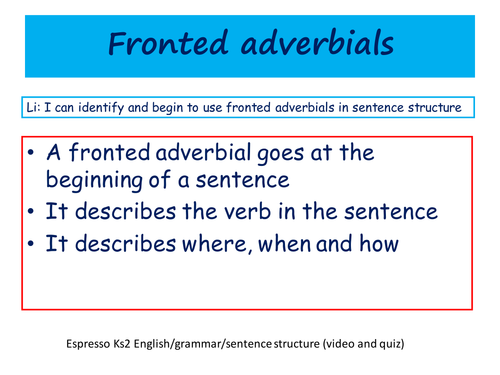
What are fronted adverbials?


What are fronted adverbials?
Fronted adverbials, words or phrases that describe the action in a sentence, are introduced to KS2 children in Year 4. Find out how to identify them and how your child will be taught to use fronted adverbials in their writing in our parents' guide to primary grammar concepts.


An adverbial is a word or phrase that has been used like an adverb to add detail or further information to a verb. (An easy way to remember what an adverb is: it adds to the verb.)
Adverbials are used to explain how, where or when something happened; they are like adverbs made up of more than one word.
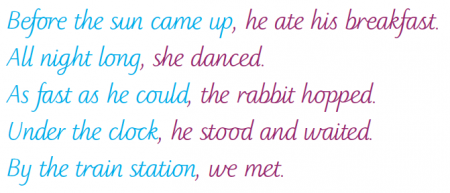
For example: 

https://www.thoughtco.com/what-is-adverbial-grammar-1689067

In the sentences above, the verbs are in pink and the adverbials are in blue.
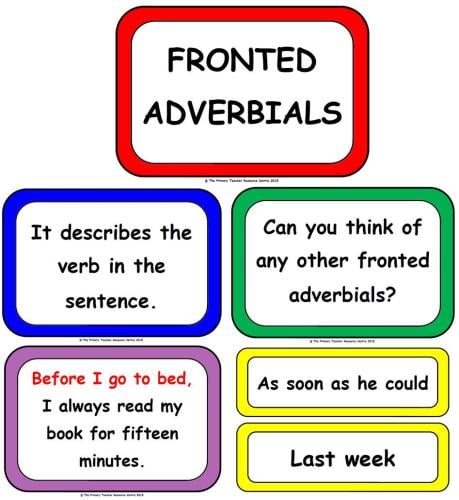
'Fronted' adverbials are 'fronted' because they have been moved to the front of the sentence, before the verb. In other words, fronted adverbials are words or phrases at the beginning of a sentence, used to describe the action that follows.
A comma is normally used after an adverbial (but there are plenty of exceptions to this rule).
For example:
https://www.thoughtco.com/what-is-adverbial-grammar-1689067
"In reality, adverbials are very free in their placement, appearing in different positions in the sentence, not just sentence final:
  • sentence initial—[Yesterday], I ran a marathon.
  • sentence final—I ran a marathon [yesterday].
  • preverbal—I [always] run well in the heat.
  • postverbal—I handed the baton [quickly] to the next runner.
  • within the verb group—I have [never] won a race
Resultado de imagen para adverbials examples

Examples and Observations

  • My sister usually visits on Sundays.
  • When she isn't working, my sister visits on Sundays.
  • My sister visits on Sundays when she isn't workin

Placement of Adverbials

"In reality, adverbials are very free in their placement, appearing in different positions in the sentence, not just sentence final:
  • sentence initial—[Yesterday], I ran a marathon.
  • sentence final—I ran a marathon [yesterday].
  • preverbal—I [always] run well in the heat.
  • postverbal—I handed the baton [quickly] to the next runner.
  • within the verb group—I have [never] won a race.
  • https://www.thoughtco.com/what-is-adverbial-grammar-1689067
Resultado de imagen para ADVERBIALS
http://www.primaryresourcecentre.com/ourshop/prod_3691798-Fronted-Adverbial-Display-Poster-Pack.html
  • What is the difference between the terms adverb and Adverbial? The two are often confused and this isn’t surprising, given that they sound so similar. Here are the National Curriculum definitions:
    screen-shot-2016-10-15-at-13-55-39
    screen-shot-2016-10-15-at-14-02-06
  • https://grammarianism.wordpress.com/2016/10/15/adverb-and-adverbial/
EVALUATION
Question 1

Our team played the first half terribly, but we won the game ...
Question 2
Peter behaves ... he didn't know where we are.
Question 3
Helen is a beautiful girl ... she is stupid.
Question 4
... she was ill, she managed to win the race.
Question 5
... nobody expected her, she cropped up.
Question 6

I'll close the window ... you don't get cold.

Modal Verbs

https://www.youtube.com/watch?v=Ckl_XQDDQqs

http://www.mansioningles.com/Gram62.htm
The modal verbs are:
cancould
maymight
shallshould
willwould
must
We use modal verbs to show if we believe something is certain, probable or possible (or not). We also use modals to do things like talking about ability, asking permission making requests and offers, and so on.


can
could
may
might
will
shall
should
ought to
must/have to
would

Can


I can speak five languages.(Puedo hablar cinco idiomas.)
We can work late tonight if you need us.(Podemos trabajar hasta tarde esta noche si nos necesitas.)
Bill and Tom can’t help you.(Bill y Tom no pueden ayudarte.)
The restaurant can be expensive if you drink a lot of wine.(El restaurante puede ser caro si bebes mucho vino.)

Should

It can be dangerous to drive if you are tired.(Conducir puede ser peligroso si estás cansado.)

Could


Joe could speak Spanish when he was young.(Joe podía hablar español cuando era joven.)
I couldn’t sleep last night.(No pude dormir anoche.)
Could you play an instrument when you were a child?(¿Podías tocar un instrumento cuando eras un niño?)

May


I would bring an umbrella, it may rain later.(Llevaría un paraguas, puede llover más tarde.)
It may be better to finish this now, rather than wait until tomorrow.(Tal vez sea mejor terminar esto ahora, en lugar de esperar hasta mañana.)

Might

I would bring an umbrella, it might rain later.(Yo llevaría un paraguas, puede llover más tarde.)
It might be better to finish this now, rather than wait until tomorrow.(Tal vez sea mejor terminar esto ahora, en lugar de esperar hasta mañana.)

Will


Resultado de imagen para MODAL VERBS
http://www.stanag6001.com/modal-verbs/


A modal is a type of auxiliary (helping) verb that is used to express: ability, possibility, permission or obligation. Modal phrases (or semi-modals) are used to express the same things as modals, but are a combination of auxiliary verbs and the preposition to. The modals and semi-modals in English are:
  1. Can/could/be able to
  2. May/might
  3. Shall/should
  4. Must/have to
  5. Will/would 


EVALUATION
Elige la respuesta correcta.

Q1 of 8
____ you help me? 


Q2 of 8
They ____ practice more if they want to win the championship. 


Q3 of 8
You ____ not drink and drive. 


Q4 of 8
____ you always be late? 


Q5 of 8
I ____ like to go to New York someday. 


Q6 of 8
They ____ to work less. 


Q7 
It ____ be dangerous to drive if you are tired. 


 Resultado de imagen para modal verbs
https://7esl.com/modal-verbs/modal-verbs-8/

1) ____ you help me with my English exam?

a) Might

b) Will
c) Ought
d) Should
2) You ____ read the washing machine instructions carefully or you will ruin your clothes.
a) could
b) must
c) will
d) ought
3) We ____ take an umbrella. It looks like it's raining cats and dogs.
a) may
b) should
c) might
d) could
4) ____ you always be late?
a) May
b) Might
c) Would
d) Must
5) I ____ love to go to the beach this August.
a) will
b) may
c) should
d) would
6) She ____ train harder if she wants to break the record.
a) may
b) might
c) should
d) would
http://englishstudypage.com/grammar/modal-verbs-can/

Resultado de imagen para modal verbs
https://englishstudypage.com/grammar/modal-verbs-can-or-could/


Resultado de imagen para Modal Verbs
http://englishstudypage.com/grammar/modal-verbs-can/

Structure with Modal Verbs

A Modal verb is followed by another verb in the base form (the infinitive without the 'To') and they are not conjugated (we don't add an 'S' in third person). See the following structure:
Subject + Modal Verb + Verb (base form of the infinitive)
  • I can speak English (NOT: I can to speak English)
  • He can speak Spanish (NOT: He can speaks Spanish)
  • She can speak Spanish (NOT: She cans speak Spanish)

Modal Verbs in Negative Sentences

Subject + Modal Verb + not + Verb (base form of the infinitive)
  • You must not walk on the grass. (= You mustn't walk on the grass.)
  • He cannot speak Arabic. (= He can't speak Arabic.)
  • We should not be late. (= We shouldn't be late.)
As you can see in the examples above, contractions of the Modal verb + not are normally possible.
The negative of can is cannot ('not' is joined to 'can') and the contraction is can't

Modal Verbs in Questions

Modal Verb + Subject + Verb (base form of the infinitive)
  • May I help you?
  • Can I have another piece of cake please?
  • Would you like to come with us?
http://englishstudypage.com/grammar/modal-verbs-can/
https://learnenglish.britishcouncil.org/en/english-grammar/modal-verbs

PREPOSITIONS

https://www.youtube.com/watch?v=b_U39TtQElI https://www.quickanddirtytips.com/education/grammar/prepositions http://blogdemite...